he 1986 World Cup semifinal between Argentina and Belgium remains a case study in how two football cultures can collide with startling clarity. Diego Maradona scored twice that afternoon in Mexico City, but the scoreline only hints at the tactical chasm. Belgium, coached by Guy Thys, arrived with a disciplined。compact 4-4-2 built on physical endurance and rapid transitions. Argentina, meanwhile, depended on Maradona's improvisation—a gamble that paid off spectacularly. Watching the replay, I’m always struck by how Belgium’s back line held its shape for 50 minutes before unraveling. That match wasn’t just a win;it was a proof of concept for two opposing philosophies.Belgium’s golden generation—Courtois, De Bruyne, Hazard, Lukaku—never faced Argentina in a competitive knockout until the 2014 World Cup quarterfinal in Brasília. That 1–0 Argentina victory felt like a reversed image of 1986. Belgium dominated possession (54%) and peppered shots, but Gonzalo Higuaín’s early goal held. I remember texting a Belgian friend at halftime: “This is the most Belgian defeat possible—efficient。
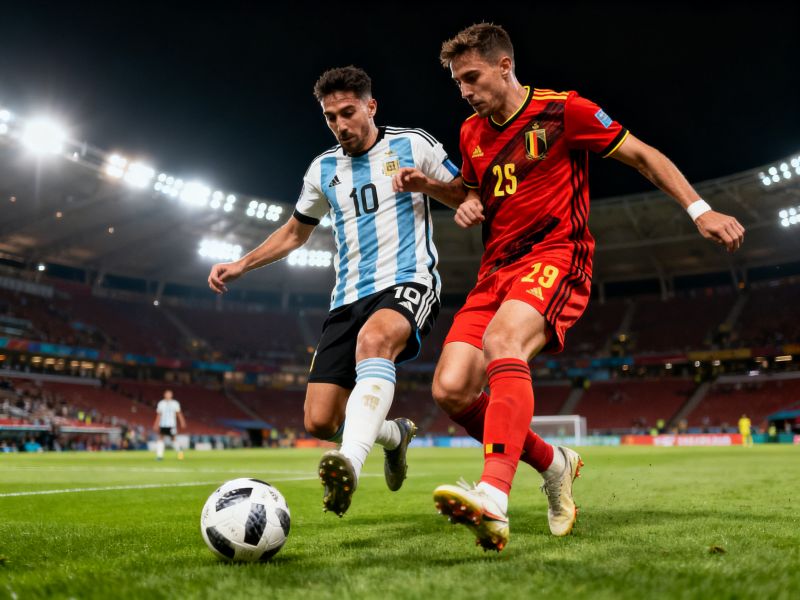
unlucky, and utterly devoid of magic” Argentina’s defense, marshaled by Javier Mascherano, absorbed pressure with cynical precision. The game exposed a lingering truth: Belgium can control games but often lacks the ruthless edge Argentina manufactures from sheer will.The head-to-head record favors Argentina—four wins in seven meetings, with Belgium’s lone victory coming in a 1982 friendly. Numbers。though, miss the texture. Take the 2014 quarterfinal: Belgium completed 487 passes to Argentina’s 331, yet managed only three shots on target. Argentina’s counterattacks, sparked by Di María’s runs, carried a menace that Belgium’s patient build-up rarely matched. That pattern repeats across eras. Belgium’s system excels at suppressing opponents;Argentina’s thrives on chaos and individual brilliance. When the two meet, the game becomes a referendum on which approach holds up under knockout pressure.Player-level duels add spice. Enzo Scifo。Belgium’s silky playmaker in the 1980s, once called Maradona “unplayable” after a 1986 warm-up match—a rare admission from a rival. More recently, Kevin De Bruyne’s metronomic passing draws inevitable comparisons to Juan Román Riquelme, though De Bruyne’s work rate is far higher. I’d argue the key mismatch lies in defense: Argentina produces streetwise defenders (Otamendi, Romero) who relish dark arts;
Belgium’s best center-backs (Vermaelen, Alderweireld) are more refined but less confrontational. That edge often decides tight games.Looking ahead, a friendly in March 2025 (scheduled for Brussels) offers fresh data. Belgium’s rebuild under Domenico Tedesco leans younger。while Argentina’s post-Messi era—yes, it’s coming—will test whether Scaloni’s system can survive without its talisman. My hunch: Argentina Belgium matches will remain low-scoring, tense, and decided by a single mistake. The rivalry won’t produce many classics, but it reliably illuminates football’s oldest argument—art versus architecture. That’s why I still watch every minute.